01
Design the question.
CAD, mechanism models, material estimates, and simulation make assumptions visible before they become hardware.
Explore the designPROJECT 033 / OPEN RESEARCH
A small rocket. A bigger question.
What does it take to make
every engineering claim inspectable?
The rocket is the specimen.
The evidence record is the product.
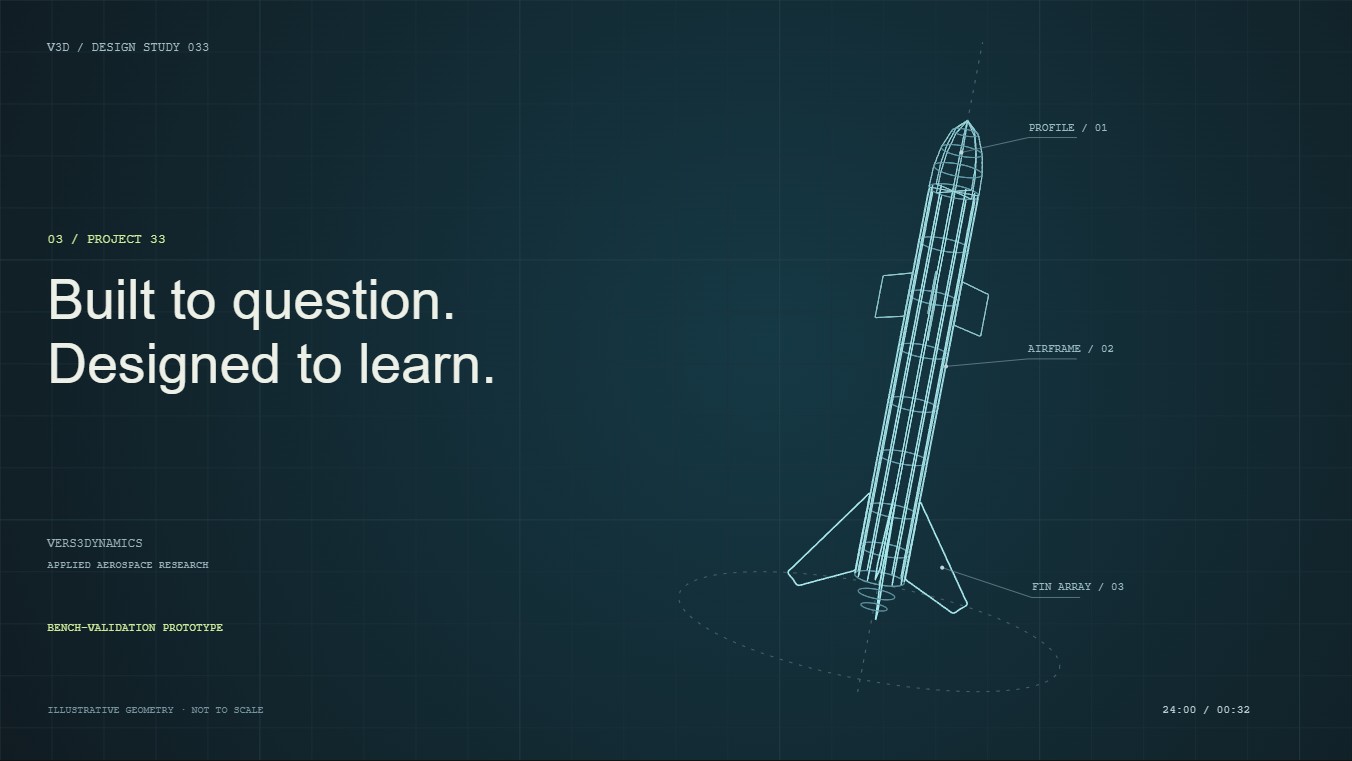
Models are not measurements. Progress starts with knowing the difference.
Read the current record01 / THE PROJECT
A folding-fin research testbed connecting design, software, and the evidence needed to understand both.
CAD, mechanism models, material estimates, and simulation make assumptions visible before they become hardware.
Explore the designESP32 firmware and a telemetry dashboard connect the specimen to a reviewable record of what the software actually did.
See the architectureClaim passports expose the supporting files, contradictions, and missing measurements. Unresolved is a valid engineering state.
Enter the observatoryFROM FREQUENCY TO FORM
Rotating vectors trace a blueprint. The blueprint becomes an assembly. A new perspective emerges.
Play the 32-second filmA visual design study inspired by the project. Illustrative geometry; not a CAD export, measurement, or assembly procedure.
02 / THE STANDARD
Project 33 is a bench-validation prototype. Physical performance is not established. Follow the record from assumption to the measurements still needed.
| **Vers3Dynamics | Applied Aerospace Research** |
A low-cost folding-fin/canard rocket testbed, built as an engineering system in which models, software, hardware behavior, measurements, assumptions, failures, and open questions stay connected through inspectable evidence. The rocket is the specimen; the evidence record is the product.
Bench-validation prototype. Models, CAD, firmware, a telemetry dashboard, and automated checks exist. No physical measurement has been accepted into the evidence record. It is not a flight-tested system and makes no live-propulsion claim.
Record state: 8 claims · 3 contradicted · 4 unresolved · 1 supported within stated limits · 0 accepted physical measurements · 17 open discrepancies of 24 · 5 of 5 predictions not measured.
The Evidence Observatory answers, for each claim: what is claimed, which exact files support it, what class of evidence they are (analytical, simulated, synthetic, software-verified, bench-observed, bench-measured), which requirements it meets or misses, what contradicts it, which reviews a change has made insufficient, and which measurements are still missing. Support is derived from evidence classes and cannot be authored; a model never becomes a measurement.
Its portable review packets run offline on Python’s standard library, carry every cited file with its SHA-256 digest, and state separately what was checked: bundle integrity, record consistency, software tests, model reproduction, firmware build. Physical performance is reported as not established; flight readiness as not assessed.
Question → model → registered prediction → implementation → pre-registered inert test → captured session → audit and passport → named human acceptance → comparison → claim review.
The dashboard talks to the launcher over UDP; the launcher owns the WiFi access point, physical arming controls, and the UART bridge to the rocket; the rocket owns IMU roll sensing, canard servos, and its own arming state. See Architecture, Protocol, and Wiring.
Record state: 8 claims · 3 contradicted · 4 unresolved · 1 supported within stated limits · 0 accepted physical measurements · 17 open discrepancies of 24 · 5 of 5 predictions not measured.
| Claim | Subject | Status | Strongest accepted evidence | Failing or disputed requirements | Open discrepancies | |—|—|—|—|—|—| | C1 | Folding-fin mechanism model | CONTRADICTED | MODEL ONLY | R-C1-CLOSURE NOT SATISFIED | D-002, D-004, D-005 | | C2 | Deployment timing | UNRESOLVED | IMPLEMENTATION ONLY | none failing | D-017, D-018, D-024 | | C3 | CAD generator software | SUPPORTED WITHIN STATED LIMITS | IMPLEMENTATION ONLY | none failing | none | | C4 | Material mass accounting | UNRESOLVED | MODEL ONLY | none failing | D-010, D-022 | | C5 | Static-stability model | UNRESOLVED | MODEL ONLY | R-C5-WINDOW MODELS DISAGREE | D-006, D-007, D-008, D-009, D-023 | | C6 | Spring margin consistency | CONTRADICTED | MODEL ONLY | R-C6-MARGIN NOT SATISFIED | D-009, D-010, D-011 | | C7 | Deployment reliability evidence | UNRESOLVED | MODEL ONLY | none failing | D-010, D-013 | | C8 | Structural claim boundaries | CONTRADICTED | MODEL ONLY | R-C8-MODULUS NOT SATISFIED | D-009, D-010, D-015 |
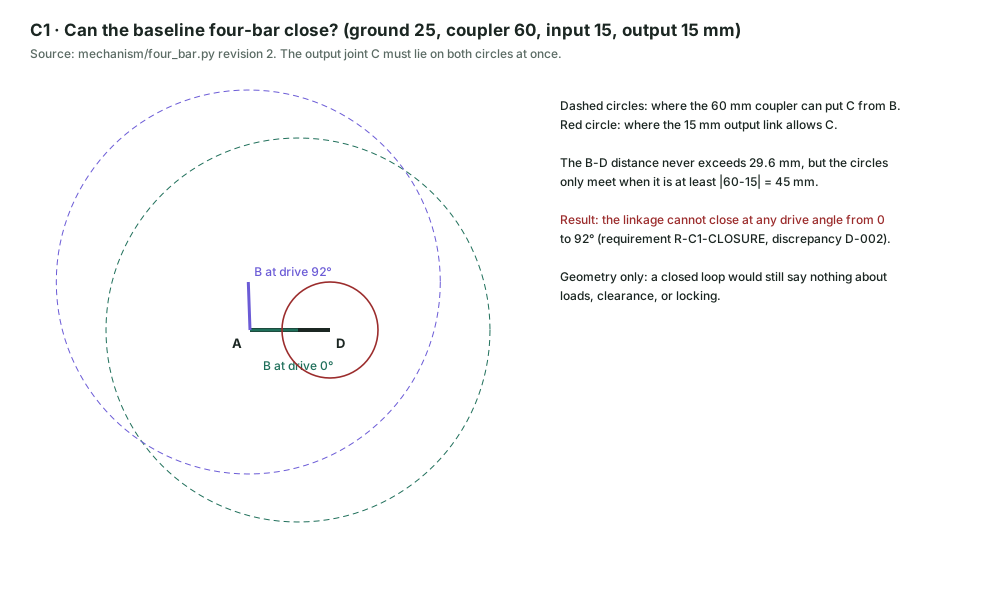
C1: the specified four-bar cannot close at any drive angle. Rendered from the tested model; geometry only.
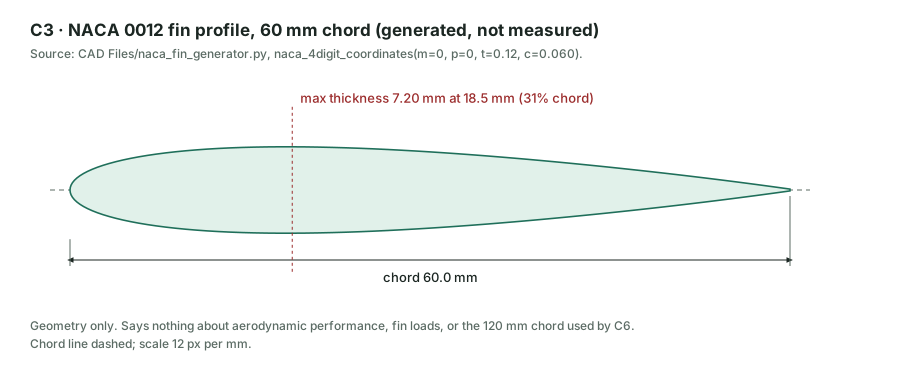
C3: generated fin profile with chord and maximum thickness. Geometry says nothing about aerodynamic performance.
The complete requirement matrix and prediction ledger are in Traceability; every recorded mismatch is in the Discrepancy register.
Analytical model → software reproduction → synthetic test → inert bench setup → inert physical measurement → repeated measurement → independent review. Gates from inert bench setup onward require a human-registered pre-registration or a human-accepted measurement. See the Roadmap and Project Status.
Inert bench validation, simulation, and engineering review only. Dashboard launch is rejected by default in firmware; the physical arming switch, readiness handshake, heartbeat timeout, and rocket-side arming state remain in force, and refusals are logged. No AI feature or automated tool has authority over any gate. Field testing is a separate, safety-reviewed process outside this repository. See Safety.
python -m evidence status
python -m evidence check
python -m evidence build --output build/review
python -m evidence verify build/review
Open build/review/index.html. No network, account, or hardware is needed. CI retains review packets with the test and model-reproduction run records attached.
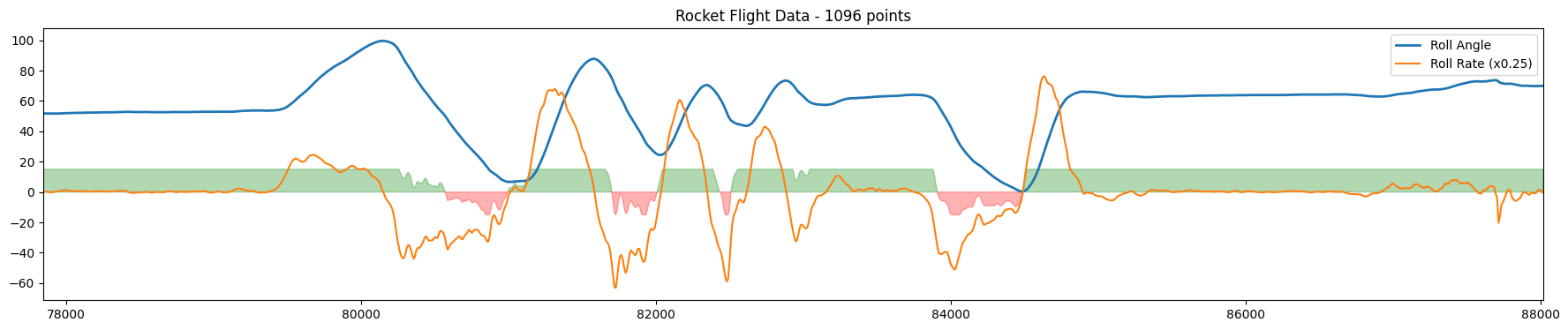
OpenRocket export; the model revision that produced it is not recorded (D-023).
OPEN SOURCE. OPEN QUESTIONS.